Production/Directing MFA
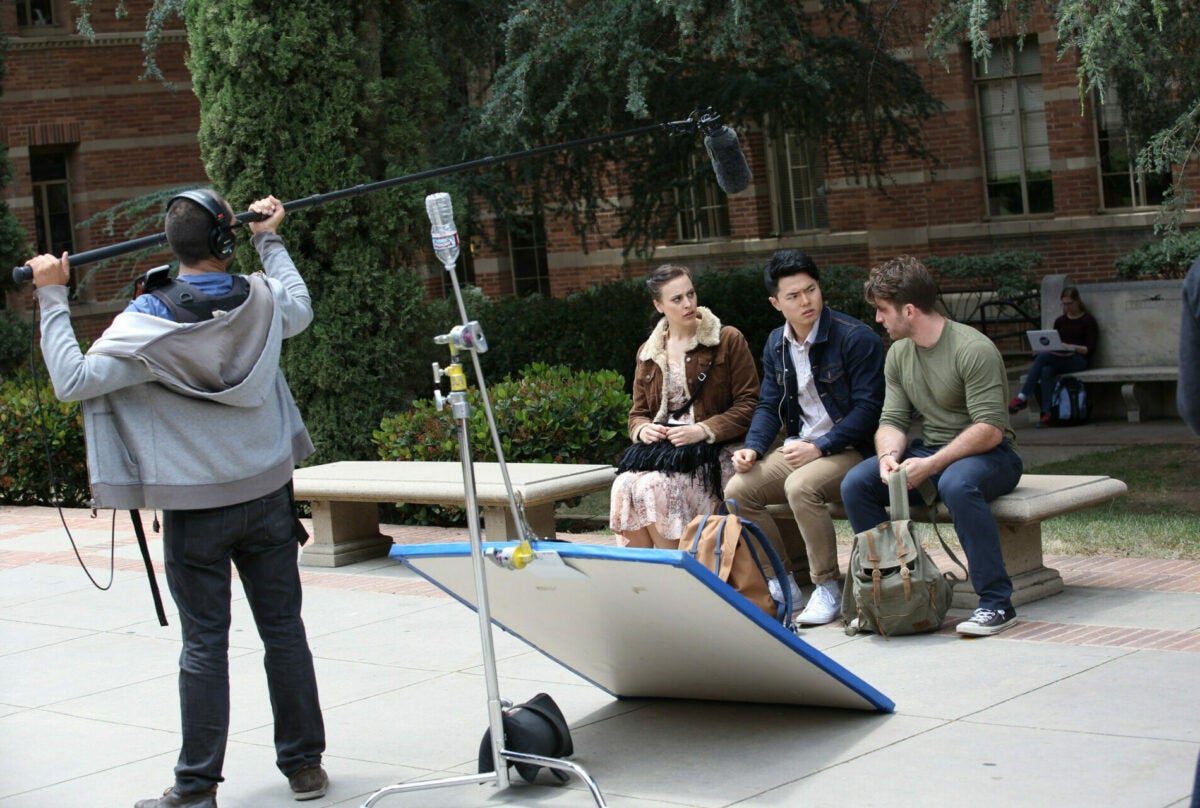
At every stage of the curriculum our students are at work on their own films.
The art of collaboration
The first year of the program is an intensive workshop in the collaborative process of production that culminates in each student completing a short (2-5 minute) sync sound 16mm film. The curriculum includes film and television writing, directing, cinematography, editing, sound, and production planning.
Working closely with a faculty mentor on an advanced project
The second year of the program allows for the further development of the student-mentor relationship as the student completes an advanced directing project in narrative, non-narrative or experimental film or video, and takes critical studies and advanced craft courses.
Thesis production launched in third year
No later than the second quarter of the third year, the student begins work on his or her thesis production, which is to be completed by the end of the fourth year. Thesis productions can be in either medium, in any form, with a maximum length of 30 minutes.
II. Summary:
The Directing Program has a twelve-quarter time-to-degree requirement. The minimum total units required to graduate is 72 units (18 courses). Only 16 units of FTV 596ABC may be applied towards the total course requirement and only 8 of these may be applied towards the minimum graduate course requirement. Only 4 units of 596A and 4 units of 596B may be taken prior to advancement. FTV596D though F may be taken after advancement.
III. Courses:
A. Required Courses:
FIRST YEAR CURRICULUMFall Quarter
- 410A SYMPOSIUM
- 410B CINEMATOGRAPHY
- 410C POST PRODUCTION
- 410D POST PRODUCTION SOUND
- 409 DIRECTING THE ACTOR FOR THE CAMERA
- 433 WRITING FOR THE SHORT FILM
- 401 FILM ANALYSIS
Winter Quarter
- 410A SYMPOSIUM
- 410B FILM PRODUCTION WORKSHOP
- 410E PRODUCTION
- 298A FINAL CUT PRO
Spring Quarter
- 410A SYMPOSIUM
- 410C POST PRODUCTION
- 410D POST PRODUCTION SOUND
- 405 TELEVISION PRODUCTION WORKSHOP
- 452C PRODUCTION SOUND
SECOND AND THIRD YEAR
- 423A ADVANCED DIRECTING THE ACTOR (required for students who will make a dramatic fiction thesis)
B. FTVDM Elective Requirement:
TWO CINEMA AND MEDIA STUDIES SEMINARS, one must be completed no later than the quarter you advance to candidacy (list of courses below), and ONE OTHER COURSE in the department that is outside of the Production program (animation, screenwriting or producers program). Seminar courses that are approved to fulfill the Cinema and Media Studies requirement:
Plus choose one course below:
- 203 FILM AND OTHER ARTS
- 204 VISUAL ANALYSIS
- 206A EUROPEAN FILM HISTORY
- 206B SELECTED TOPICS IN AMERICAN FILM HISTORY
- 206C AMERICAN FILM HISTORY**
- 207 EXPERIMENTAL FILM
- 209A DOCUMENTARY FILM
- 208B CLASSICAL FILM THEORY**
- 208C CONTEMPORARY FILM THEORY
- 209B FICTIONAL FILM
- 209D ANIMATED FILM
- 217 SELECTED TOPICS IN TELEVISION HISTORY**
- 217A AMERICAN TELEVISION HISTORY**
- 218 CULTURE, MEDIA AND SOCIETY
- 219 FILM AND SOCIETY
- 220 TELEVISION AND SOCIETY
- 221 FILM AUTHORS
- 222 FILM GENRES
- 223 VISUAL PERCEPTION
- 224 COMPUTER APPLICATIONS FOR FILM STUDY
- 225 VIDEOGAME THEORY
- 246 ELECTRONIC CULTURE
- 270 FILM CRITICISM
- 271 TELEVISION CRITICISM
- 277 NARRATIVE STUDIES
- 298AB SPECIAL STUDIES (select classes must see Graduate Counselor)
Please note that not all courses are offered every quarter. Students should consult the registrar's schedule for available courses and class times. For courses in the 298 series, students should consult the graduate advisor first to check whether a course fulfills the CMS requirement.
**These courses are sometimes taught as a core course for M.A. students and may not be available that particular quarter for MFA students.
** courses are sometimes taught as a core course for MA students and may not be available that particular quarter to MFA students.
PROGRAM FOCUS
A. FIRST YEAR: A FOCUS ON PROCESS
The first year is a highly intensive program operating on a six-day schedule with the regularly scheduled courses enhanced by all-day technical craft training on Saturdays. The first quarter provides basic background in video, cinematography, sound, editing, the directing of actors and the camera, the organizing of production, and short fiction screenwriting. The second and third quarters are devoted to intensive production work focusing on process leading to six minute sync sound film with clearly defined parameters that must be completed during the academic year if a student is to continue in the program. Two evaluation sessions with the first year faculty will be required of all students. The first will occur at the end of Fall Quarter. The second, a First Year Review, will take place at the end of the spring quarter with the purposes of determining fitness to continue in the program, advising on curriculum for second year professional training, and the selection of Second Year Advisors.
B. SECOND YEAR: A FOCUS ON PROFESSIONAL TRAINING
Second year training is intended to develop professional skills. Courses are constructed around two pivots: 1. Mentor relationships established by students with their Second Year Advisors involving multi-quarter course sequences in the specialized areas of: Narrative Film, Documentary, Multicamera Television Production, Experimental Media and Cinematography. 2. Advanced training in various areas of the craft enhanced by critical studies courses. All projects begun during the second year associated with any of these courses must be completed no later than the middle of the eighth quarter of residency.
C. THIRD YEAR: A FOCUS ON PRODUCTION EXPERIENCE
Third year training is committed to the planning and production of a Thesis Film (no more than 30 minutes). The Thesis process involves the following elements: 1. Extensive pre-production planning prior to advancing to candidacy. FTV 486 is available for a student to work with a faculty in preparation to advance. 2. Specialized craft courses and critical study courses can continue to be taken based on the needs of the individual student, but should not impede progress on the thesis. 3. * Advancement to candidacy must take place by the winter quarter at latest. 4. *Advancement to candidacy will be based on a signed contract clearly defining the parameters of the project including budget, time line, film length, and advising procedures.
D. FOURTH YEAR: COMPLETION
The fourth year is used for completion of the thesis project. The twelve-quarter limit will be strictly enforced.
Your Checklist
Notice for applicants affected by Hurricane Sandy: If the storm and its resulting closures affected your ability to submit your application by the November 1st, 2012 deadline, please email filmgrad@tft.ucla.edu an explanation of your situation, including where you live. Deadline extensions will be provided based on your current situation.
All Theater, Film and Television degree programs are full-time only. We only accept students for the Fall Quarter. This admissions information is for Fall Quarter 2013.
THE GRE IS NOT REQUIRED FOR MFA APPLICANTS
Click here for a helpful note from Production/Directing Head of Graduate Admissions.
- Apply online to UCLA Graduate Division by November 1, 2012.
- Departmental application instructions. Print and complete the Departmental application. Choose MFA – Production/Directing. Please submit by mail.
- Complete and submit the following supplemental information. All written Supporting Material must be typed and on 8-1/2 by 11 paper with at least a 12-point font. The lengths indicated are the maximum allowed. Make sure your name is on each page and that all pages of each section are stapled together.
- An original treatment that is no longer than 2 pages in length, 12 point font, describing a short film that might be produced during graduate residence at UCLA. No adaptations or feature script treatments will be accepted. Material that is longer than the above guidelines may not be read. Please do not combine the statement of purpose and film proposal; they are two separate documents. Due to the high volume of applications, submitted material will not be returned. Please do not send scripts, DVD's, or tapes. Please submit a hard copy of the uploaded document by mail.
- Two official transcripts from all undergraduate and graduate work are required. NOTE: Community college transcripts are not necessary, as the coursework will be reflected on your undergraduate transcript. Please have transcripts sent to address below or include sealed envelope in application packet.
- Statement of Purpose. A 1-2 page document giving the faculty a sense of who you are. What do you hope to achieve by participating in the program? What are your professional goals? How do you plan to achieve them? Please submit a hard copy of the uploaded document by mail.
- Three Letters of Recommendation. Please enter the names and other information about your recommenders in the online Graduate Division Application. Letters may be submitted electronically or by mail.
International applicants
- Whose first language is not English, official test results from the Test of English as a Foreign Language (TOEFL) or the International English Language Testing System (IELTS) IS REQUIRED unless,
- the applicant who holds a bachelor's or higher degree from a university located in the United States or in another country in which English is both the primary spoken language and the medium of instruction, or who have completed at least two years of full-time study at such an institution, are exempted from both the TOEFL/IELTS requirement and the ESLPE. Please be sure to include such information in your application.
- TOEFL UCLA institution code – 4837 / Department code – 83. The overall minimum TOTAL score required is 87. For more information about UCLA TOEFL requirements, click here.
- Required Academic Records – Please click the link for UCLA Graduate Division requirements.http://www.gdnet.ucla.edu/gasaa/admissions/ACADRECS.HTM. ORIGINAL or CERTIFIED COPIES OF ALL ACADEMIC RECORDS IN ENGLISH AND NATIVE LANGUAGE ARE REQUIRED. This includes transcripts, diploma, and degree certificate. The degree conferral dates must be noted on the documents
Please send all items designated by mail to:
Graduate Film Counselor
UCLA Department of Film, Television and Digital Media
103 E. Melnitz, Box 951622
Los Angeles, CA 90095-1622
Application postmark deadline: November 1, 2012
For U.S. Citizens and Permanent Residents interested in receiving financial aid, note that the Fellowship Application and Financial Aid Application (FAFSA) deadline for UCLA is March 2, 2013. Applicants must complete the FAFSA by this date if they want to be eligible for all awards, work-study, and fellowships that UCLA offers.
Please visit our FAQ page for if you have additional questions
For Prospective Students:
- E-mail: filmgrad@tft.ucla.edu
- Phone: 310-206-8441
- Office: 103 East Melnitz Hall
For Current Students:
Film, Television & Digital Media Counselor: Erica Flener