
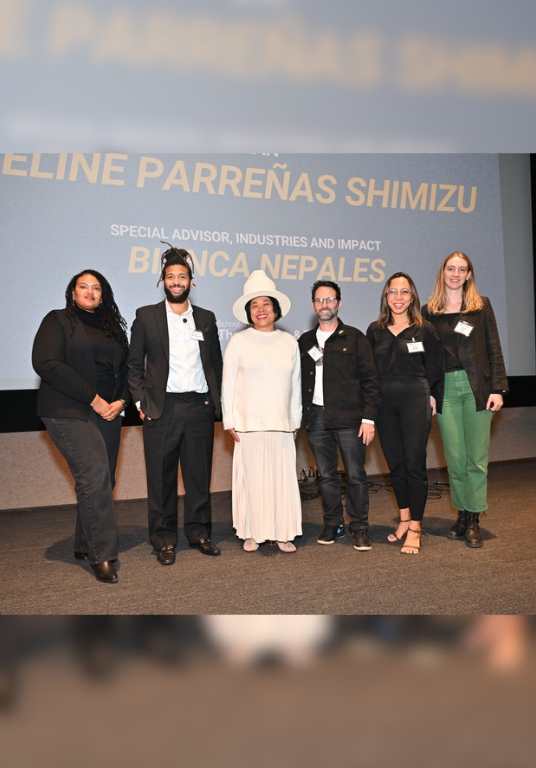
At the top public film and theater school in the world, a new vision for AI and storytelling is taking shape. And it looks nothing like Silicon Valley.
Celine Parreñas Shimizu, Dean of UCLA TFT and Distinguished Professor of Film, Television and Digital Media, opened the inaugural AI + Storytelling Summit with a declaration about art, “The arts matter here — desperately, deeply,” she said. “Because AI is a question of human creativity, imagination and of ethics and equity, of whose dreams get encoded into our future.” For the Dean and UCLA TFT, AI is not disruption. It is an invitation to defend, protect and play as human creators.
In 2025–2026, UCLA TFT conducted a series of internal summits examining how AI improves staff productivity, how it is used by students and faculty, and the role it plays in film and theater research. Building on these internal conversations, the AI + Storytelling Summit brought together artists, entrepreneurs and scholars from around the world to foster collaboration across industry, community and higher education. The collective conversation explored the future of scholarship, creative practice and pedagogy in the age of AI.
The Summit was curated and organized by Associate Dean for Research and Creative Technology and Theater Department Chair, Professor Jeff Burke, alongside technology entrepreneur Ben Relles and UCLA TFT AI Fellow Devon Baur, in collaboration with UCLA Digital and Technology Solutions.
Chris Mattman, UCLA’s inaugural Chief Data and Artificial Intelligence Officer, spoke early in the program, underscoring the institution’s collective responsibility to steward AI with care.
Hosted in the James Bridges Theater, the audience was filled with artists, academics, technologists and industry leaders. Dean Celine gave the room its assignment: take notes, reflect, write. “Since I am a professor and this is a classroom,” she said, “homework is required.”
Creative Rebellion Is Our Inheritance
The Summit was grounded in the School’s founding commitments: empowering every student to craft an independent vision through a project, innovating to transform how art is experienced and making a meaningful impact on the world.
“Diverse voices matter more than ever,” Shimizu said. And the thread of what human creativity is capable of and who gets access to the conditions that make it possible ran through every session.
UCLA TFT runs on creative rebellion. The L.A. Rebellion was a social movement from the late 1960s through the early 1990s that emanated from the work of TFT faculty and students enrolled in UCLA’s Ethno-Communications Program. Their filmmaking centered marginalized communities, challenged dominant representations and created new and needed forms of storytelling for Black, Asian American, Chicana/o and Native American artists.
“This is our inheritance,” Shimizu said. “Artists who transformed the short form into a space for creative rebellion, experimentation and new ways of seeing the world, one film at a time. Today, AI opens new possibilities for that same spirit of exploration. Higher education must be a place where artists have the freedom to play, to challenge conventions and to imagine what comes next alongside industry and community.”
The Summit took place amid a nationwide day of protest against federal immigration enforcement policies, a moment of collective action and civic urgency that Dean Shimizu acknowledged in her opening remarks. “Our work as storytellers is deeply connected to the movements and moments that shape our world.” The Summit moved forward as an investment in civic engagement.
The convening was perfect for a university campus, where experimentation thrives and new possibilities take shape. Situated at the intersection of the world’s leading entertainment industry and a world-class public research university, UCLA TFT is uniquely positioned to explore the possibilities of AI while asking critical questions about its impact on art and humanity. “This is where we experiment freely, where we fail, where we ask uncomfortable questions. This is the site where we lead — where we build technology in service of human creativity, not the other way around.”
Students Reimagine What’s Possible
A backdrop to the day was a video installation on loop in the UCLA TFT VR Lab. APROVACA, by MFA filmmaker Bora Rex, is a docufiction piece about an orchid conservation nonprofit in Panama, edited in real time by seven large language model agents responding to environmental data from the El Valle de Antón cloud forest. As climate change destabilizes the ecosystem, the film’s own timeline grows unstable. It is, in the most literal sense, a living document.
Other featured work included graduate student pieces at the intersection of AI and artistic form. Animator Gina Whitney presented The Gloomwrath, which used AI for background generation, compositing and image upscaling. Animator Matt Haro presented Van Helsing’s Journal, created as part of the Amazon GenAI Innovative Storytellers Fellowship. Maria Paula Avila Vera shared Tell Me About a Complicated Man, a controlled experiment in how AI exaggerates and distorts culturally loaded visual prompts across a story set on a Bollywood film set. Theater scenic and production design student Bianca Bishop and collaborators presented Xanadu — Spring 2025’s immersive stage production of the cult classic that wove extended reality and AI into the audience experience, inviting them to join the characters’ creative journey in real time.
Putting Artists First
Two platforms showcased distinct models for artist-centered AI. Grammy-winning musician Imogen Heap joined virtually alongside Greg Ipp to present Auracles, a platform designed to ensure musicians own and control their metadata. Don Allen Stevenson III presented Asteria Film, the generative AI studio founded by Natasha Lyonne and Bryn Mooser, built on “clean models” that fairly compensate the artists whose work trains them. Both platforms center consent, control and compensation — a framework that echoed throughout the afternoon.
Between sessions, TFT Professor and Chair of UCLA Asian American Studies Sean Metzger facilitated audience discussions. In asking how scaling with AI might improve rather than replace human artistry, responses included expanding opportunities for people with disabilities, expanding the capacity for idea generation and increasing the ability to focus on vision rather than tedious execution. A word cloud with thoughts on artist-driven platforms included most prominently the terms agency, empowerment, humanity and revenue sharing.
Panel 1: Unlocking New Stories
Moderated by TFT Professor Steve Anderson, who holds a joint appointment in the Department of Design Media Arts, the panel featured Don Allen Stevenson III, Jagger Waters (College of Influence; UCLA Theater alumna), Verena Puhm (Dream Lab LA) and Mariana Acuña Acosta (Promise).
Puhm, a filmmaker and writer, said that AI lets her visualize stories without being constrained by others’ cinematic language or by budgets that would otherwise kill a project. Acuña Acosta observed that artists are becoming orchestrators — constructing pipelines and doing world-building in real time. Stevenson raised the defining tension: audiences increasingly want to see human authorship visible in the work, even as AI makes execution faster than ever.
Waters called for higher education to include learning the creator economy. And more than training on the tools of the creator economy, teaching the inner confidence and curiosity that keeps an artist grounded when the landscape keeps shifting.
Stevenson’s advice was pointed: take an improv class. “Theater matters most,” he said. Presence, responsiveness, real-time collaboration are what no model can simulate, and exactly what the next generation of storytellers needs to own.
Panel 2: New Markets for Artists
Liz Randall (CAA), Travis Atreo (Fanded), Greg Ipp (Auracles), Paris McCoy (TEC Leimert) and Ben Relles explored artist-centered economic opportunities in AI, from preserving ownership of metadata to connecting artists directly with their fan bases.
Randall was direct: IP law is not catching up anytime soon, which makes it all the more urgent that artists remain at the center of creation, rather than merely data sources. Atreo noted that streaming platforms expose artists to audiences while leaving many broke, and that solving distribution and ownership is the next frontier.
McCoy pushed students to stop asking whether they qualify as creative technologists and simply claim the title. “You decide where AI fits in your creative practice and in your identity as an artist,” he said.
Making the Unmakeable Film: From Deepfakes to Deep Truths
A fireside chat brought together documentary filmmaker David France (How to Survive a Plague, Welcome to Chechnya), who joined virtually, and Fred Grinstein (Machine Cinema).
Grinstein opened with a short talk he called “AI and the Truth,” which examined the duality between creative possibility and dangerous deception. He offered stronger frameworks for thinking about AI and nonfiction truth-telling.
France discussed his Peabody Award-winning Welcome to Chechnya (2020), that used deepfake technology to protect the identities of LGBTQ+ Chechens fleeing brutal persecution. Their faces were replaced with those of queer activists and supporters who volunteered, a new definition for creating a human shield. France reflected on the ethics of AI in documentary filmmaking, and on the layers of consent obtained at every stage to ensure everyone’s safety.
A Call to Connect and Collaborate
The Summit closed as it began, with astute observations from Dean Shimizu. She championed AI for its ability to protect and preserve vulnerable truths while acknowledging that “[AI] presents a different perspective on ethics…that we need to continue studying and investigating.” Her closing call to action was one of collective curiosity, creative courage and connection: “Let’s meet each other and explore this new technology changing the ground of our human creativity. Harness aggressive friendliness. Connect, collaborate, consult.”
Leading With Human Creativity
From student lightning talks to industry panels, the AI + Storytelling Summit showcased a creative community already experimenting, innovating and leading. AI is reshaping every aspect of storytelling, from how stories are developed and financed to how they are performed and shared. The artistic, ethical and professional implications of these changes are still unfolding.
At UCLA TFT, the conversation about AI begins with the human experience. How can this technology expand creative possibilities while protecting the voices, perspectives and experiences that make storytelling essential? Who controls the image? Who owns the voice? Whose stories are represented and whose are left out? What does consent mean in an era of synthetic media? These are not simply questions about technology. They are questions about art, ethics and the future of human creativity.
This approach is rooted in the School’s history of creative rebellion. When Dean Shimizu invoked the L.A. Rebellion, she connected the artists who challenged established conventions and transformed cinematic storytelling to a new generation exploring what is possible with AI. That same spirit of experimentation, critical inquiry and creative independence continues to guide the work of UCLA TFT students and faculty today.
Situated at the intersection of the world’s leading entertainment industry and a world-class public research university, UCLA TFT brings artistic exploration and academic rigor to a rapidly evolving field. Here, students have the freedom to experiment, challenge assumptions and imagine new possibilities while considering the broader impact of their work. The goal is not simply to teach artists how to use emerging technologies, but to encourage them to ask why, for whom and to what end.