
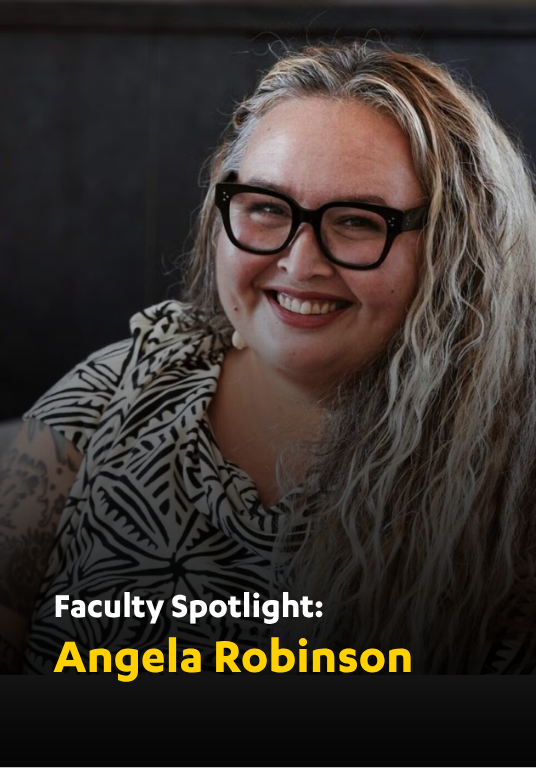
Angela Robinson (she/her) is an Assistant Professor of Theater and Performance Studies and an anti-colonial Chuukese scholar. Robinson specializes in Indigenous feminisms, sciences, and ontologies, Pasifika performance and cultural production, interrelations of the human and more-than-human, and global social movements for climate justice.
Q: WHAT ARE YOU WORKING ON RIGHT NOW, AND WHAT EXCITES YOU MOST ABOUT IT?
My first book project, Colonial Climates, has taken up most of my time recently. It’s a love/hate affair, but I am very excited to bring it into the world soon—especially to highlight the incredible work so many Pacific Islanders are doing to deal with climate change. It is ultimately a story of resistance and perseverance, waged at a planetary level by some of our most vulnerable communities. As I write this, I’m sitting on the balcony of my childhood home in Oʻahu, where Hurricane Lowell passed last night and we’re preparing for another hurricane right on its tail. I am here to watch a new play from Hawaiʻi Theatre Center on endangered animals for one of my book chapters. So, my excitement about this work comes from two very distinct places: the joy of seeing, writing about, and sharing innovative performances, and the urgency of adding to a growing chorus calling for lasting climate transformation.
Q: WHO OR WHAT HAS BEEN YOUR GREATEST INFLUENCE ALONG THE WAY IN YOUR TEACHING AND RESEARCH?
I have had so many incredible mentors that I continue to seek guidance from, but my ultimate influences are my mother and maternal grandparents. My grandfather, who was chief of our village, was formally educated by the Japanese colonial administration in Micronesia during WWII. He instilled the importance of education in our family, and every year during high school, my mother would cry goodbye to her family before getting on a boat to travel to school where she would spend the entire year away from home. I think of the education they both received under such difficult circumstances and feel immensely privileged not only to have studied under significantly less stress, but to be able to continue that legacy of valuing and furthering education.
Q: WHAT LED YOU TO BRING TOGETHER PERFORMANCE, CLIMATE JUSTICE, AND INDIGENOUS KNOWLEDGE AS ONE BODY OF WORK?
Honestly, it was a natural coalescence of my own interests and passions, but so much of it was led by the climate justice organizers and activists themselves. In the 2000s, as the climate justice movement grew louder and more organized, I noticed that performance was a constant mode of expression, particularly among the Indigenous groups. There is a long history of performance being used to agitate and bring awareness for social justice movements, and I see this as part of that continuum, while also very much being a part of Indigenous traditions and cultures where caring for the environment, storytelling, and performance are integral, interconnected aspects of life.
Q: AS A UCLA PHD ALUM, HOW DOES IT FEEL TO BE BACK ON CAMPUS AS A JOINT-APPOINTED PROFESSOR IN THE THEATER DEPARTMENT?
Oh, it’s lovely! It feels really full circle in many ways. When I graduated with my PhD from UCLA in 2019, I received the commencement award, which basically meant I led the line of PhD students and gave a speech at commencement. In my speech, I called on UCLA to do more for Native students. Seven years later, I was hired in part through an initiative from the Chancellor’s office to better serve Indigenous students across UCLA. So, it’s an honor and a responsibility I happily embrace. Another anecdote: as a student, I often parked in Lot 3 and walked through Macgowan when it rained. I loved peeking into the rooms to see what the students were working on, thinking they seemed to be having so much fun. How wild that a few years later my office is in that very building and I get to teach these students!
Q: WHAT ADVICE WOULD YOU GIVE TO STUDENTS WHO WANT TO MAKE A DIFFERENCE THROUGH THEIR WORK?
In Indigenous Studies, we talk a lot about being in good relation with people, creatures, the land, and the sea—not just to make a difference, but to make a difference that lasts. Recently, I attended a talk by a wonderful First Nations scholar, and someone asked, “How do you know you’re doing things in good relation?” The scholar responded, “Because you’re always annoyed!” They explained that because you are constantly checking in, compromising, and listening to different sides, doing work in good relation can be frustrating. So, my advice to students would be that even in those hard, trying moments, that’s part of the lesson, right? Real, impactful work is meant to be hard, but that’s also why you have professors, staff, peers, and support systems to lean on. You don’t have to do it alone.