
Lauren “Keke” Palmer’s UCLA TFT Residency Moves from Self-Discovery to the Art of the Pitch
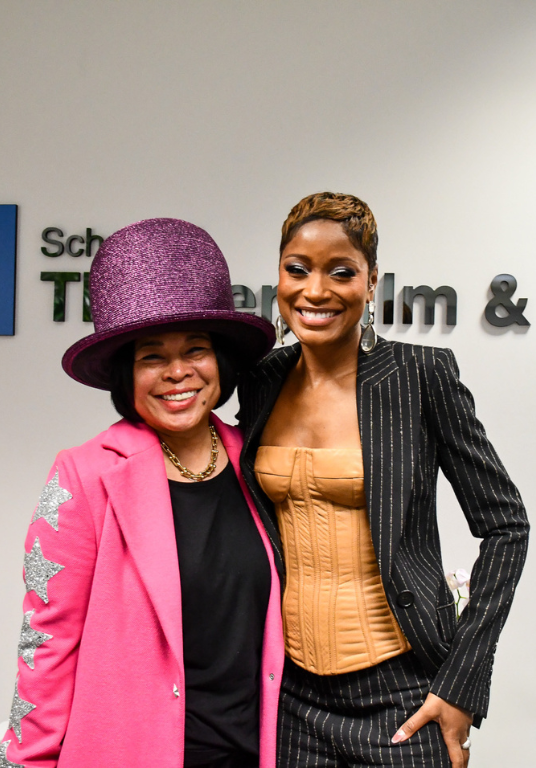
“Your Voice. Our Story.” moves students from defining their distinct artistic identity to developing and pitching an original concept, moving students from defining who they are to articulating what they make
LOS ANGELES, CA — UCLA School of Theater, Film and Television (TFT) unveils the student assignment at the center of Lauren Palmer’s 2026–27 Artist-in-Residence program: a two-part syllabus that asks students to first articulate what makes their artistic voice their own, and then to pitch a concept from that singular perspective.
The program is an extra-curricular enrichment opportunity open first to enrolled TFT majors followed by TFT minors, space permitting. Registration is on a first-come, first-served basis.
Developed by Dean and Distinguished Professor Celine Parreñas Shimizu in partnership with Palmer, the assignment runs across the academic year and puts the residency’s central ideas of self-knowledge, creative ownership and freedom through community into practice. Students begin by creating a Brand Book that defines their artistic identity independent of any single project. They then apply that identity to an original concept, culminating in selective pitch sessions with Palmer designed as a shared learning experience for the entire audience.
“Students should leave with an actual portfolio artifact, not just an experience,” said Artist-in-Residence Lauren Palmer. “Every assignment in the framework is built to produce something students can point to afterward. In the Fall, the students arrive at their own voice. By Spring they are pitching from it. The assignment will teach them how to move forward in advancing their story.”
The sequence extends the central proposition of Palmer’s residency, Know Yourself, Own Yourself, Free Yourself to Build New Frameworks for Change: that an artist’s ability to create independently begins with the ability to name oneself. Rather than beginning with a project and asking students to shape themselves around it, Palmer reverses the order by requiring a unique identity to dictate the project. Students first determine what is distinct and legible about their voice and then build from that perspective.
“Lauren Palmer’s assignments follow the spirit of the L.A. Rebellion,” said Dean Celine Parreñas Shimizu. “As a student at TFT, Julie Dash (Daughters of the Dust) held that her creative vision was fundamentally individual, a viewpoint entirely her own that could not be replicated by anyone else. UCLA gave her the creative independence to build that voice, and she used it to center the specific, unique situations of Black women, a commitment she carried from her early shorts through to her features. Lauren Palmer and I designed this sequence in that tradition, so that students name themselves and speak their story in a world where each of us is too easily spoken for by others.”
Fall Quarter: The Brand Book
Following Palmer’s Fall session on “Knowing Yourself,” students will be invited to create a Brand Book: a portfolio artifact designed to articulate who they are and what makes their work distinctly their own.
Students will develop a brand identification statement, mood board, five-year plan, and brand deck, which will ultimately comprise their Brand Book. The work is informed by readings selected by Dean Shimizu from Jacques Lacan, Jean Baudrillard and Frantz Fanon, bringing theoretical frameworks about identity, image and the experience of being seen by others into conversation with Palmer’s own experience growing up in public and learning to author her identity and work.
Palmer describes the assignment as a “playground” that allows students across performance specialties to arrive at an identity specific to their practice. “I’m here to demonstrate the process of becoming your own,” said Lauren Palmer, “the evidence that you can carve your own path through specificity. The point is for each student to find their own distinct approach.”
Students will submit their Brand Books for consideration and selected works will be discussed at the Winter session.
Winter and Spring Quarters: The Pitch
The second phase asks students to put their self-discovery to work.
During the Winter session, Palmer will teach students how to translate a defined artistic identity into a pitch for one original project where the format is deliberately undefined, encouraging students to create a work befitting their vision. Students will be assigned development and submission of a pilot project. From these submissions, Palmer will select projects to be pitched and discussed live, using each as an opportunity to learn about the process of articulating a creative vision.
“The classroom is a sacred space where students should be able to experiment, take risks and discover what they are capable of without the pressure of having to be discovered,” said Shimizu. “This project is not about turning the classroom into an audition room. It is about giving our students the opportunity to practice what they will be asked to do beyond UCLA: know who they are, articulate what they make and stand behind their creative vision. What makes the classroom sacred is the freedom to learn. The learning is the prize.”
Across both assignments, the lasting value is in the work students create and the skills they develop. Every participating student leaves with tangible portfolio material and practice articulating a vision.
“When students know what is singular about their voice, they can create from a place that no one else can occupy,” said Shimizu. “That is what we want them to carry from the classroom into the world: the confidence and practice to make work that could only come from them.”
The Assignment, In Brief:
Fall: Know yourself. Define your artistic identity. Build the Brand Book.
Winter: Own yourself. Learn how to move from identity to idea and articulate what you make.
Spring: Free yourself. Put the art of the pitch into practice. Bring your voice into the world.
———
About UCLA School of Theater, Film and Television
The UCLA School of Theater, Film and Television (TFT) is a premier global interdisciplinary professional school, dedicated to developing visionary creators, industry leaders and scholars whose diverse and innovative voices inspire change for a better world. Consistently ranked among the world’s top entertainment and performing arts institutions, TFT offers a dynamic curriculum advancing the study and creation of live performance, film, television, digital media, and emerging algorithmic technologies. Its distinguished bachelor’s and Master’s degrees span acting, directing, writing, producing, animation, cinematography, design (costume, lighting, set, and sound), and research-based professions in arts institutions and archives. TFT’s doctoral alumni in theater and performance studies, as well as cinema and media studies, teach at leading universities in the U.S. and around the world.
About Lauren Palmer / KeyTV
Lauren Palmer is an Emmy Award-winning actor, recording artist, producer, bestselling author, television host, and entrepreneur whose career spans film, television, music, publishing, and digital media. Working professionally in entertainment for over 25 years, Palmer has become one of the few contemporary artists to sustain a career across multiple creative industries while continually redefining the boundaries between performer, producer, executive, and founder. Her work reflects a sustained commitment to creative authorship, ownership, and the development of new institutional models that expand opportunities for emerging artists. In 2021, Palmer founded KeyTV Network, a creator-first media platform dedicated to cultivating diverse voices through original programming, education, and distribution. Conceived as both a production company and a creative ecosystem, KeyTV reflects Palmer’s broader philosophy that lasting change in the entertainment industry requires not only representation within existing institutions but the creation of new ones. The platform attracted more than 760,000 subscribers within its first three months and has continued to grow across digital platforms while supporting the work of emerging filmmakers and storytellers.
Media Contact
Jacquie Henderson
jhenderson@tft.ucla.edu | (310) 206-2830
UCLA School of Theater, Film and Television
202 East Melnitz Hall ∙ Los Angeles, CA 90095