
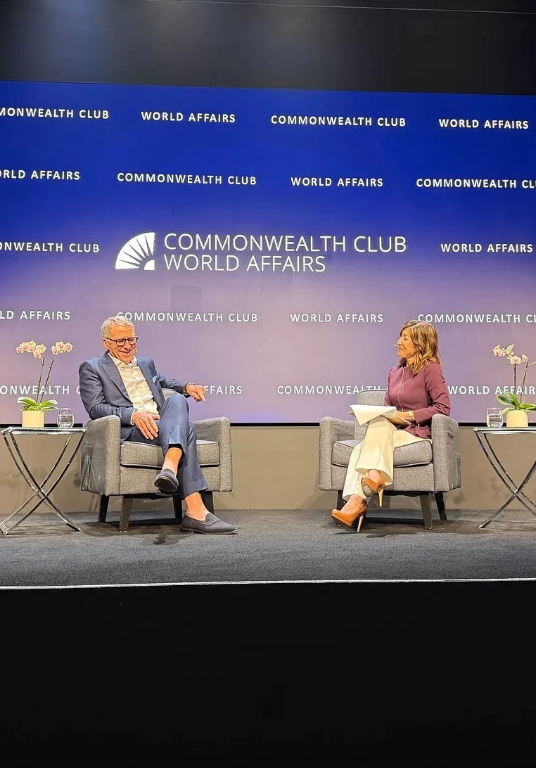
President JB Milliken at the Commonwealth Club in Conversation with ABC7’s Kristen Sze (Berkeley, Class of 1991) on January 29, 2026
March 03, 2026
By Celine Parreñas Shimizu,
Dean of the School of Theater, Film and Television,
and Distinguished Professor of Film, Television and Digital Media
University of California at Los Angeles
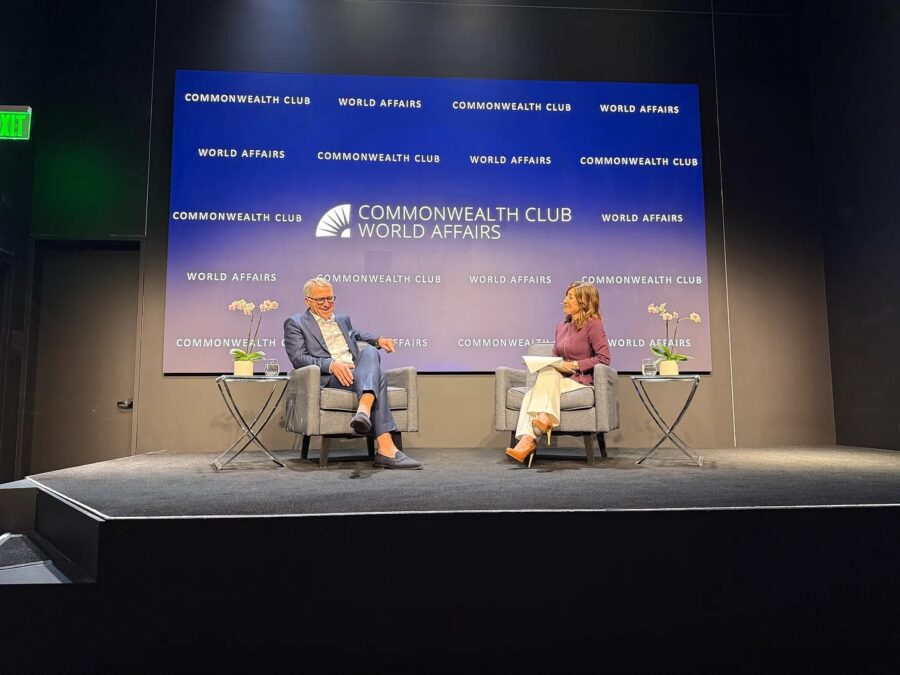
In the intimate setting of the Commonwealth Club in San Francisco on January 29, 2026, in conversation with ABC Channel 7 news anchor Kristen Sze, an alumna who asked hard questions, President JB Milliken is leading UC through a time of unprecedented attacks — federal funding threats, budget pressures, falling confidence in higher education, political winds shifting against public universities. What struck me about meeting him was an optimism grounded in the vigilant reading of history and civics, which I argue is critical in the fight for protecting the mission of the university.
He presented clearly what he called his nonnegotiables: UC will not compromise on independence, governance, and academic freedom. The values that define UC so students and faculty can thrive.
Even as the ticketed event began with protesters inside and then outside the auditorium — delaying the start of the conversation — interviewer (and UC Berkeley alumna) Kristen Sze made sure to address their concerns about poverty, labor, and housing issues throughout the exchange as she inserted their language into the conversation.
The Story UC Needs to Tell
We need to do better at telling the story of UC, Milliken says. People don’t have information about the university. They underestimate the resources available. First-generation students, for example, don’t know the real purchase price essentially. We can do a lot to educate people early about what UC actually offers and what it costs.
This matters because the story is powerful: he says that 65 percent of resident graduates pay no tuition. The average debt is $21,000 for four years. He presents this data under the assertion that all graduates from UC must have the same opportunities — otherwise we can lose hope. If students are standing together at commencement, they need to have had equal opportunity to get there and to get out. UC must be that equalizer.
Talent is Universal, Opportunity is Not
His conviction in this phrase “talent is universal, opportunity is not,” ran throughout the conversation: UC as an engine of social mobility, committed to making high-quality education available to all. This includes the importance of resources in eradicating hunger and providing counseling and career services to support students once they’re there.
He’s a huge believer in the community college system — an important part of the ecosystem where all should thrive. He cited Clark Kerr’s memoir The Gold and the Blue as a touchstone. As the principal author of the 1960 Master Plan, Kerr would not recognize the UC now — three times the campuses, three times the student body — yet the mission remains clear, perhaps more urgent than ever.
Put Down the Phone. Pick Up a Book.
This is where I add to what Milliken didn’t say directly — though lived beneath what he did say.
We are in a moment when the instinct is to scroll. To refresh, to risk induction into a dopamine-fueled stupor of algorithms trained to fulfill our desires so that algorithms that prefer lies, according to Maria Ressa, may decide our perceptions, where our shared reality is being questioned at a time of erasure. Better understanding of this moment — the pressures on public universities, the erosion of civic trust, the long contest over who gets to learn and who gets left out — requires something the feed cannot give us and what reading can: depth indeed, absorbing history, the clarifying framing of data, and the willingness to sit with complexity.
Read history to see the present more clearly. Milliken himself is steeped in it — reading books at a time, returning to Clark Kerr, understanding UC in the sweep of what happened after World War II, when higher education became the great engine of social mobility. It assures me that our president uses context to inform his decisions. May it steady him to know well that history shows us how institutions have faced these pressures before. What held and what broke. What we’re actually defending — and why.
Read poetry, too. As Audre Lorde says, out of necessity and not luxury. Poetry is how women of color speak themselves into existence so as to say, what I feel matters, let me speak it to call out the wrong. Beyond saying, yet truly saying: I was here. The costs. The meaning that comes from reflecting upon experience. When students — first-generation students, students from communities that universities once excluded — find their voices on these campuses such as in June Jordan’s Poetry for the People at Cal, that is the institution working to serve its communities. Poetry reminds us that the people who make up UC bring different histories, different wounds, different gifts. And we co-author this institution together, across all of it. We need each other, our stories show us how.
This institution is ours — across our differences, across our disagreements, across the protest inside the auditorium and the conversation on stage. The question is whether we will claim it. Whether we will show up literate in its history, and willing to shape its future and the strength and clarity of vision that requires.
The Humanities Matter
Milliken returned again and again to the humanities — as essential and central to leading a good life, far from STEM as the be all end all of things. He worries that we may lose the study of subjects that help people understand civic traditions, political systems, what it means to be a citizen. How to lead a useful, happy life was a repeated theme towards how to participate in civil society as citizens born through one’s education in the UC.
“How to be a citizen, especially in the age of AI, is critical,” he said. The fastest chip matters, yes — and so does being exposed to great literature. It’s an important part of being alive and participating in society.
When asked what major he would create, he settled on the simplest answer: “I would major in humanities as a great prescription for a happy life.”
Milliken means this seriously. If we do not understand our institutions — through their history, their contested origins, their ongoing negotiation — we cannot defend them. And if we cannot speak about them with precision and feeling both, we cannot bring others along.
AI and the Future of Education
AI is changing higher education, research, and how we work. It will change how we teach, the classroom experience, medicine and more. UC organically leads on how it affects teaching and research — not just watching from the sides. AI is born here and lives here in the UC.
Milliken acknowledged the disruption AI presents. Faculty are grappling with it every day. The question is how to teach, test, and ensure rich experiences that force students to grapple deeply with ideas and come up with their own thinking. How to balance the use of AI with academic integrity.
Here technology becomes crucial for UC’s future: how to use it to expand access beyond the current 300,000 students, to offer credentials and certificates throughout people’s careers. A way for people to return to their alma maters lifelong. A reservoir where people train for life, forever a well to draw.
Yet even as he describes this future, Milliken grounds it in something ancient: colleges have been around since 1088 in Bologna. There’s something people crave in the classroom you’d still recognize from the 11th century. Something enduring. Something human. To read literature is to know how to be a citizen prepared for what comes next. The strength to help with that encounter comes from reading, to think, to be changed by the pages of knowledge creation made in the university.
Campus Climate and Safety
On allegations of antisemitism, Milliken was clear: make sure to eradicate it so it has no existence. We will not compromise on values that define UC.
When asked how to protect students, he said: “One thing that matters most is to ensure safety of people on campus — foremost the students entrusted by family. Safety for all is number one priority.”
He addressed the broader question of campus climate — are campuses welcoming? Are there groups who feel less free? His answer: UC welcomes all speech and all views. Classrooms should be civil spaces. And the university must use every available tool to maintain that environment.
He rejected what he called “ideological accusation versus pursuit of truth” — the university’s commitment must be to truth-seeking, not to any particular ideological position.
What We Owe Each Other
In the end, what struck me most about this conversation was its underlying faith — that people, given real information, given real access, given the tools to think and read and argue well, will rise to meet the moment.
That faith is not naïve. It is historical. It is what the UC was built on.
Faith requires tending however. We have to stop scrolling as a main source of pleasure. Read the history of the institutions you inhabit. Read the poets who came from communities like yours — and communities nothing like yours. Understand what has been built here, what it cost, and what it still demands of us. Make movies and books about the UC. Sing its song.
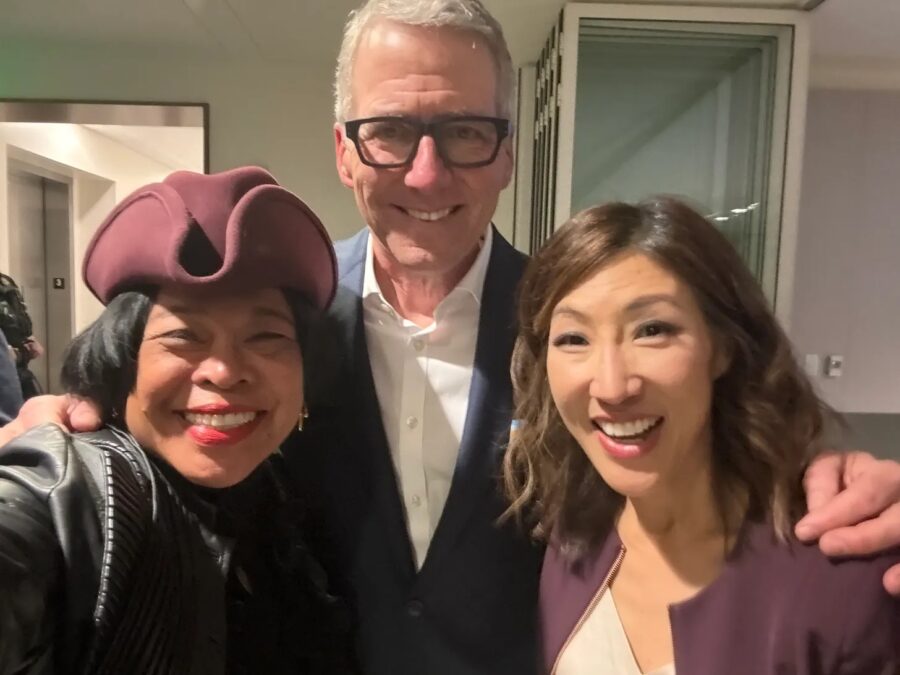
This institution is ours to co-author. Across our differences. Across our grievances and our hopes. Let us shape it together equipped by the knowledge about what we are shaping.